

# every security model has a root of trust. yours calls on sundays.
summary
You use a password manager. You have hardware security keys. Your laptop is encrypted and your SSH keys have passphrases. You did a whole talk on zero trust.
None of that matters, because your mom knows the answers to all of your security questions, is on your phone plan, still has your work laptop logged in from Christmas, and will tell all of this to anyone who calls and sounds polite.
yourmom2root is an unauthenticated, remotely triggerable privilege escalation chain that goes from "stranger with a phone" to root on your infrastructure. It requires no exploit code. It requires one phone call and, in some cases, the patience to hear about the neighbor's hip surgery.
live demo
help, osint, call mom, history, cat passwords.txt, ls ~/Desktop. Or press the button.details
| CVE | CVE-2099-0001 |
|---|---|
| Affected | All moms. Including yours. Especially yours. |
| CVSS 3.1 | 10.0 Critical AV:P/AC:L/PR:N/UI:N/S:C/C:H/I:H/A:H. AV:P stands for "Phone". UI:N because she will pick up before it rings. |
| Weakness | CWE-640 Weak Password Recovery Mechanism CWE-200 Exposure of Sensitive Information (to the whole church group) CWE-312 Cleartext Storage of Sensitive Information (sticky note, fridge) CWE-1188 Insecure Default ("of course, sweetie") |
| Privileges required | None. Saying "I'm a friend of your son's" grants elevated trust. Saying "I'm from the bank" grants all of it. |
| Impact | Full account takeover, lateral movement to your employer, and a voicemail asking why you didn't tell her you were hacked. |
| Vendor response | "I don't know what any of this means, but I'm proud of you." |
attack chain
- Reconnaissance. The target's public Facebook profile provides your full name, birthday, hometown, high school, first pet, and a photo captioned "So proud of my baby's first day at his new job!!" in which your badge is clearly legible.
- Initial access. Attacker calls mom. Mom answers on the first ring. Mom always answers on the first ring unless it's you.
- Credential harvesting. Attacker asks a single security question. Mom answers it, then answers three more nobody asked, then asks if the attacker is single.
- MFA bypass. The one-time code is sent to your number. Your number is on her family plan. She reads it out loud, including the part that says "never share this code."
- Lateral movement. Your work laptop has been open at her house since December 26th "so you can check your emails when you visit." It is not locked. It is playing a cooking video.
- Privilege escalation. You gave her an admin account in 2015 so she'd stop calling about the printer. It's still there. So is the printer problem.
- Persistence. She has your spare house key, your Netflix login, your childhood medical records, and an unshakeable belief that you'll call more.
am i vulnerable?
mitigations
- Set your security question answers to random strings. She will still know them. Nobody knows how.
- Remove mom from your phone plan. Not recommended. See: Thanksgiving.
- Enroll her in security awareness training. She will score 100%, then forward the certificate to 31 people with the subject line "FW: FW: is this real??"
- Ask her to stop posting personal details. She will post a screenshot of the request with the caption "my son the computer expert lol."
- Set up a password manager for her. It will be fine until the master password goes on a sticky note.
- Call your mother. This does not fix anything, but she'll be less likely to tell a stranger everything because she's lonely.
disclosure timeline
| Day 0, 09:00 | Researcher calls the vendor to report the issue. |
|---|---|
| Day 0, 09:04 | Vendor provides an update on the neighbor's hip surgery. |
| Day 0, 09:41 | Vendor confirms the vulnerability by reading out the researcher's own security answers, plus the name of his childhood dentist. |
| Day 1 | Vendor forwards the advisory to the extended family. |
| Day 1, 14:12 | Aunt Linda replies-all. |
| Day 2 | Vendor asks if this is why the researcher "never calls." |
| Day 90 | Disclosure deadline. Vendor is still asking if he got her text. The text was a thumbs-up. |
industry reaction
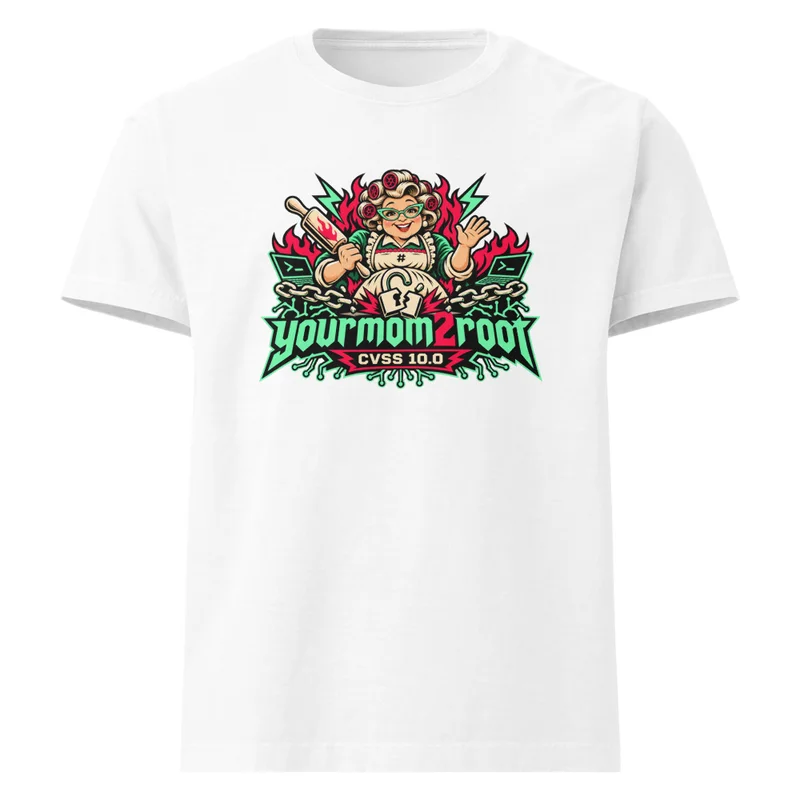
patch (merch)
faq
Is this real?
The CVE is fake. The attack chain is, unfortunately, a pretty accurate description of how a lot of account takeovers happen. Go set up a password manager with your mom this weekend. Bring snacks.
Does this affect dads?
Dads are tracked separately as CVE-2099-0002 (dad2root). He'll give anyone the Wi-Fi password, but only after a 20-minute explanation of how he set up the router.
Is there a bug bounty?
Yes. Payout is leftovers you didn't ask for, in a container you are required to return.
Why the name?php2shell, nginx2root and friends established the naming convention. This one targets the most widely deployed and least patched component in the world.
Is there a conference talk?
Submitted to DEF CON. Rejected because three reviewers said "this is just my mom."